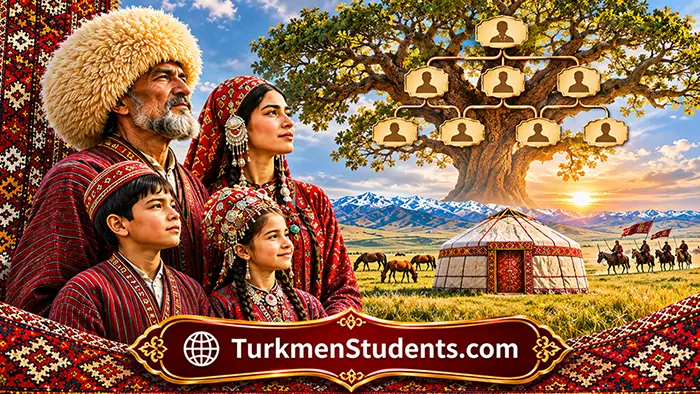
Turkmen Genealogy and Tribes: From Oghuz Khan and the 24 Oghuz Tribes to the Turkmen Clans of Iran
Introduction
The Turkmens are a Turkic-speaking people with a rich historical and cultural heritage. Their collective identity has long been associated with genealogy, kinship networks, tribal affiliations, and traditions passed down through generations.
Understanding Turkmen genealogy is not simply about identifying ancestral names or tracing family lineages. It also provides valuable insights into historical migrations, social structures, political alliances, cultural traditions, and the development of Turkmen communities across Central Asia and the Middle East.
Today, Turkmen populations live primarily in Turkmenistan, Iran, Afghanistan, and neighboring regions of Central Asia. Despite the political borders separating these communities, they share important elements of language, historical memory, and cultural heritage.
In Iran, the region known as Turkmen Sahra, particularly in Golestan Province, remains one of the most significant centers of Turkmen cultural life. Tribal names such as Yomut, Goklen, Teke, Jafarbay, and Atabay continue to play an important role in identifying family and community backgrounds.
However, several important questions arise when exploring Turkmen ancestry:
Where do the Turkmen people originate? What is the historical relationship between the 24 Oghuz tribes and modern Turkmen tribal groups? Who was Oghuz Khan, and can contemporary Turkmen families trace their ancestry directly to him?
Answering these questions requires examining both traditional genealogical narratives and historical research.
What Does Genealogy Mean in Turkmen Culture?
Genealogy, commonly referred to as shajara or şejere, is the study and documentation of family ancestry and descent.
In Turkmen culture, genealogy represents more than a record of ancestors. It forms part of the collective memory through which families and communities preserve their identity, recognize kinship relationships, and maintain connections with earlier generations.
Historically, Turkmen society was organized through various levels of family and tribal affiliation. Terms corresponding to family, lineage, clan, tribe, and tribal confederation were used to describe different social groupings.
However, these categories did not always have fixed meanings across different periods and geographical regions.
Anthropological research demonstrates that Turkmen tribal organization was not based exclusively on biological descent. Political alliances, economic cooperation, shared territories, marriage relationships, and collective social interests also contributed to the formation and transformation of tribal groups.
Consequently, membership in the same tribe does not necessarily mean that every family can establish a continuous and historically documented genealogical connection to a single ancestor.
When studying Turkmen genealogy, it is useful to distinguish between three types of genealogical knowledge:
Family genealogy: The recorded ancestry of a particular family, often extending across several generations and supported by family documents, oral testimony, and historical records.
Tribal genealogy: Traditional accounts connecting different families, clans, or tribal branches to a common ancestor. Such relationships may contain both historical and symbolic elements.
Mythological and epic genealogy: Narratives such as the story of Oghuz Khan, which have played an important role in shaping the cultural identity and historical consciousness of Turkic and Turkmen communities.
Recognizing these distinctions is essential for a reliable understanding of Turkmen tribal history.
The Historical Origins of the Turkmens and Their Connection to the Oghuz
A substantial part of Turkmen history is closely connected to the Oghuz Turks, a collection of Turkic-speaking tribal groups that occupied different regions of Central Asia.
References to the Oghuz appear in early Turkic sources and later Islamic historical writings.
During different historical periods, Oghuz populations inhabited territories around the Syr Darya River and neighboring regions of Central Asia.
From approximately the tenth and eleventh centuries onward, the name Turkmen became increasingly associated with certain Turkic groups, particularly those Oghuz communities that had adopted Islam.
Nevertheless, the historical meaning and application of the term changed over time.
During the eleventh century, major migrations of Oghuz groups into Khorasan, Iran, and Anatolia contributed to important political, cultural, and demographic transformations.
The Seljuks, who established one of the most influential medieval Islamic dynasties, emerged from this broader historical context.
Meanwhile, other Turkmen populations remained in or moved among regions east of the Caspian Sea, Khwarazm, the Central Asian steppes, and territories that later became part of modern Turkmenistan.
Over several centuries, migrations, alliances, territorial changes, and interactions among different communities contributed to the emergence of the tribal groups recognized today.
Therefore, Turkmen ancestry cannot be reduced to a single migration route or an uninterrupted genealogical line.
Oghuz Khan: The Legendary Ancestor of the Oghuz Tribes
One of the most prominent figures in Turkmen historical traditions is Oghuz Khan, also known as Oghuz Qaghan.
In the traditional narratives collectively known as the Oghuznama, Oghuz Khan is presented as the legendary ancestor and founding figure of the Oghuz tribes.
These narratives describe his life, military campaigns, descendants, and the symbolic organization of the tribes.
An important written source preserving these traditions is the Oghuz narrative included in the Jami’ al-Tawarikh (Compendium of Chronicles) by Rashid al-Din Hamadani, the medieval Persian historian.
Another major source is Shajara-i Tarakima (Genealogy of the Turkmens), written by Abu al-Ghazi Bahadur Khan, the seventeenth-century ruler of Khwarazm.
Abu al-Ghazi drew upon oral genealogical traditions and earlier written materials in compiling his account of Turkmen origins.
These works provide valuable evidence for understanding how historical communities represented their ancestry and tribal relationships.
However, modern scholarship distinguishes the cultural significance of these accounts from their historical verifiability.
The Oghuz Khan narratives combine epic traditions, collective memories, genealogical explanations, and elements of mythology.
Accordingly, Oghuz Khan occupies a central position in Turkmen cultural heritage, but the details of his life and genealogy cannot all be treated as independently established historical facts.
The 24 Oghuz Tribes and Their Traditional Classification
According to one of the best-known genealogical traditions, Oghuz Khan had six sons whose names were associated with celestial and natural elements:
- Gün Khan — the Sun
- Ay Khan — the Moon
- Yıldız Khan — the Star
- Gök Khan — the Sky
- Dağ Khan — the Mountain
- Deniz Khan — the Sea
The traditional account states that each son had four sons of his own, resulting in 24 grandsons who became the symbolic ancestors of the 24 Oghuz tribes.
These tribes were organized into two principal branches:
Bozok: Traditionally associated with the three elder sons of Oghuz Khan.
Üçok: Traditionally associated with the three younger sons.
The following table presents a widely recognized classification of the 24 Oghuz tribes based on medieval genealogical traditions.
| Main Branch | Son of Oghuz Khan | Four Associated Tribes |
|---|---|---|
| Bozok | Gün Khan | Kayı, Bayat, Alkaevli, Karaevli |
| Bozok | Ay Khan | Yazır, Dodurga, Döğer, Yaparlı |
| Bozok | Yıldız Khan | Avşar, Beğdili, Kızık, Karkın |
| Üçok | Gök Khan | Bayındır, Peçenek, Çavuldur, Çepni |
| Üçok | Dağ Khan | Salur, Eymür, Alayuntlu, Üregir |
| Üçok | Deniz Khan | İğdir, Büğdüz, Yıva, Kınık |
Note: Tribal names appear with different spellings and classifications in historical manuscripts and modern linguistic traditions. The table represents a traditional genealogical framework rather than a scientifically verified genetic family tree.
Historical sources also associate many Oghuz tribes with distinctive symbols known as tamghas.
These symbols were used for identification, marking livestock, and expressing tribal affiliation in certain historical contexts.
Are Modern Turkmen Tribes the Same as the 24 Oghuz Tribes?
The short answer is no. The traditional list of 24 Oghuz tribes cannot be directly equated with the names and organization of all modern Turkmen tribes.
The 24 Oghuz tribes belong to an early historical and genealogical tradition, whereas modern Turkmen tribal identities developed through centuries of migration, political alliances, social change, and the reorganization of communities.
For example, the name Salur, also known as Salyr, appears among the traditional Oghuz tribes and remains significant in Turkmen history.
In contrast, names such as Yomut, Teke, and Ersari do not appear in exactly the same form in the traditional list of 24 tribes.
Nevertheless, these groups became prominent in later historical accounts of Turkmen society.
Some traditional genealogies connect later Turkmen tribal groups to earlier Oghuz lineages, particularly the Salur tradition.
Such narratives are important sources of cultural and historical memory, but establishing an uninterrupted biological or genealogical connection requires independent evidence.
This distinction is fundamental when comparing ancient Oghuz traditions with contemporary Turkmen identities.
Major Turkmen Tribes
1. Yomut (Ýomut / Yomud)
The Yomut are one of the most prominent and historically influential Turkmen tribal groups.
Historically, Yomut communities occupied territories east of the Caspian Sea, parts of Turkmen Sahra, and regions of present-day Turkmenistan.
Their social organization has attracted considerable scholarly attention.
One particularly important study is William Irons’ The Yomut Turkmen: A Study of Social Organization among a Central Asian Turkic-Speaking Population, published by the University of Michigan in 1975.
This anthropological work examines kinship relationships, political structures, and social organization among Yomut communities.
Historically, Yomut groups followed different patterns of livelihood, including nomadic pastoralism, semi-nomadic activities, and settled life.
In Iran, tribal divisions associated with the Yomut include the Jafarbay, Atabay, and Aq-Atabay.
These groupings are particularly relevant to the historical geography of Turkmen Sahra.
2. Goklen (Gökleň / Göklen)
The Goklen constitute another important Turkmen tribal group, particularly associated with northeastern Iran and Turkmen Sahra.
Historical and anthropological sources describe the Goklen as having several internal divisions.
Encyclopaedia Iranica records two major historical branches known as Buzurg-Tay and Dodurga.
The organization of these branches changed over time, reflecting broader transformations in Turkmen social structures.
The name Dodurga also appears among the traditional 24 Oghuz tribes.
However, the recurrence of the same tribal name does not independently establish the direct ancestry of every family associated with it.
The Goklen have made an important contribution to the historical and cultural development of Turkmen communities in Iran.
3. Teke
The Teke are among the best-known Turkmen tribal groups in Central Asian history.
During the nineteenth century, Teke communities were particularly prominent in the Akhal and Merv regions, where they played significant roles in regional political and military developments.
The name Akhal-Teke reflects the historical association of certain Teke communities with the Akhal region.
Historical sources also mention the presence of Teke groups in parts of northeastern Iran, including areas associated with Jargalan.
Their history demonstrates the close relationship between tribal identity, geographical settlement, and regional political developments.
4. Ersari (Ärsary / Ersari)
The Ersari are an important Turkmen tribal group historically associated with eastern Central Asia, particularly territories near the Amu Darya River.
Historical accounts connect Ersari communities with regions influenced by trade, agriculture, and pastoral activities.
Ersari Turkmens are also found among the Turkmen populations of Afghanistan.
Their historical development is closely connected to the broader history of Khwarazm, Bukhara, and the commercial networks of Central Asia.
5. Salur (Salyr)
The Salur occupy an important position in both early Oghuz traditions and later Turkmen history.
The name appears in the traditional list of the 24 Oghuz tribes and is also documented in subsequent historical accounts.
Several traditional genealogies connect other Turkmen groups with the Salur lineage.
From the perspective of cultural history, the Salur tradition is especially important for understanding tribal organization, migration narratives, and epic genealogical accounts.
6. Saryk (Saryq)
The Saryk are another historically significant Turkmen group.
Historical sources associate Saryk communities with the Merv region and the Murghab River basin.
The Saryk have also attracted attention in studies of Turkmen carpets, textiles, and traditional artistic patterns.
Certain genealogical narratives connect the Saryk with broader tribal traditions associated with the Salur.
7. Chowdur (Çowdur / Choudor)
The Chowdur are another historically recognized Turkmen group.
Their name is associated with Oghuz tribal history and later Turkmen populations.
The name Çavuldur, or related variants, also appears among the traditional 24 Oghuz tribes.
Historical accounts describe Chowdur communities in northern Turkmen territories and areas surrounding Khwarazm.
The development of this tribal name illustrates how tribal identities and names could persist while undergoing historical transformation.
Turkmen Genealogy and Tribal Groups in Iran
Turkmen Sahra, situated in northern and northeastern Iran, has been one of the most important regions for preserving Turkmen tribal traditions and cultural practices.
Historical studies of Iranian Turkmens have frequently concentrated on the Yomut and Goklen, although additional tribal communities have also lived in the region.
Historical Divisions of the Yomut in Turkmen Sahra
According to historical and anthropological descriptions summarized in Encyclopaedia Iranica, the Yomut were divided into several important branches.
Jafarbay: A major historical Yomut grouping associated with the Caspian coastal region and areas around Gomishan. Historical subdivisions of the Jafarbay included groups known as Yar-Ali and Nur-Ali.
Atabay: A Yomut branch historically associated with the Aq Qala area and parts of the Gorgan plain.
Aq-Atabay: A grouping historically connected with areas around Gonbad-e Kavus.
These classifications help explain the historical settlement patterns of Yomut communities.
However, they should not be interpreted as precise descriptions of the present-day residential distribution of every family belonging to these groups.
Modern migration, urbanization, marriage, and changing social circumstances have influenced the distribution of Turkmen populations.
Historical Divisions of the Goklen
Encyclopaedia Iranica identifies Buzurg-Tay and Dodurga as two major branches within the older Goklen tribal organization.
The same source notes that parts of this historical structure underwent transformation over time.
Consequently, constructing a comprehensive contemporary genealogy of Goklen families requires additional research involving local records, family histories, and oral traditions.
Other Turkmen Groups in Northeastern Iran
In addition to the Yomut and Goklen, historical sources mention groups such as the Teke, Nokhurli, and Qarnas in northeastern Iran.
For example, historical descriptions associate the Nokhurli with the Jargalan region and the Qarnas with areas around Goli Dagh.
These references demonstrate that the tribal history of Iranian Turkmens is more diverse than a simple division into two major groups.
Tamghas and Traditional Symbols in Turkmen Tribal History
One distinctive aspect of Turkmen and wider Oghuz cultural heritage is the historical use of tribal symbols.
These marks, known as tamghas, served as identifying signs for particular groups in various historical settings.
Medieval accounts of the Oghuz include illustrations and descriptions of tamghas associated with different tribes.
Historically, such symbols could be used to identify tribal affiliation, mark livestock, or express collective identity.
Traditional Turkmen carpet weaving also incorporates distinctive geometric motifs.
Among these motifs are designs commonly described as göl or gul, which have been associated with different Turkmen weaving traditions and tribal identities.
However, tamghas and carpet motifs should not be treated as identical categories.
Carpet designs could change over time, spread between communities, and be adapted by different weaving groups.
Therefore, the presence of a particular pattern on a carpet or household object cannot, by itself, conclusively establish the tribal ancestry of its owner.
Traditional Turkmen carpet-making art was inscribed on UNESCO’s Representative List of the Intangible Cultural Heritage of Humanity in 2019.
This recognition highlights the importance of weaving traditions in preserving cultural knowledge, craftsmanship, and collective identity.
Why Do Turkmen Genealogical Accounts Differ?
Researchers and families examining Turkmen genealogy may encounter different or even contradictory accounts of the same tribal origins.
Such differences do not necessarily mean that every traditional account is inaccurate.
Instead, they may reflect the complex processes through which genealogical knowledge has been transmitted and transformed.
One important factor is oral transmission.
For many generations, family histories were preserved through storytelling rather than comprehensive written records.
As a result, some ancestral names may have been forgotten, modified, or arranged differently in separate accounts.
Migration is another factor.
Groups that moved to new territories sometimes adopted different local identities or became associated with new geographical names.
Political alliances and changing social relationships also influenced tribal organization.
Communities with different ancestral backgrounds could become members of the same larger tribal group.
Furthermore, historical authors did not always use words equivalent to clan, lineage, tribe, and tribal confederation consistently.
These factors make it necessary to compare multiple sources before drawing firm conclusions about the origins of a particular Turkmen community.
How Can You Research Your Own Turkmen Family Genealogy?
For individuals interested in documenting their family ancestry, the most reliable starting point is not Oghuz Khan or an ancient tribal figure.
Instead, research should begin with the closest generations for which verifiable information is available.
Step 1: Record Known Family Members
Begin with the names of parents, grandparents, great-grandparents, and other identifiable ancestors.
Whenever possible, record their places of birth, approximate dates, and family relationships.
Step 2: Interview Older Relatives
Speak with grandparents, elderly relatives, and other family members who may remember ancestral names, migration stories, and traditional tribal affiliations.
Record these accounts accurately and identify the person providing each piece of information.
Step 3: Examine Historical and Family Documents
Useful materials may include:
- Family records and identification documents
- Historical property deeds
- Grave inscriptions
- Personal letters and manuscripts
- Local historical records
- Family photographs and written notes
These sources can help verify relationships and clarify uncertain genealogical details.
Step 4: Compare Different Sources
Oral accounts should be compared with documentary evidence whenever possible.
If several sources provide contradictory information, the differences should be recorded rather than removed.
Step 5: Distinguish Family Names from Tribal Identity
Modern surnames, local clan names, and broader tribal affiliations do not always represent the same type of ancestral relationship.
A family surname alone may not establish descent from a particular historical tribe.
Similarly, genetic ancestry testing cannot independently prove membership in a specific historical Turkmen tribe.
A carefully documented genealogy should therefore distinguish between verified ancestral relationships, oral traditions, and hypotheses requiring further investigation.
Turkmen Genealogy: A Heritage Beyond Tribal Names
The study of Turkmen genealogy is about much more than identifying ancestors or determining tribal membership.
It is an opportunity to explore the history of communities whose identities have evolved through centuries of migration, cultural exchange, political change, and social transformation.
The legend of Oghuz Khan and the traditional classification of the 24 Oghuz tribes remain important elements of Turkmen collective memory.
At the same time, historical documents and anthropological studies provide a more detailed understanding of the development of tribal groups such as the Yomut, Goklen, Teke, Ersari, Salur, Saryk, and Chowdur.
In Iran, the diverse communities of Turkmen Sahra continue to preserve important elements of this historical and cultural heritage.
However, the study of genealogy becomes more academically valuable when traditional narratives are carefully distinguished from documented historical evidence.
Preserving family records, collecting oral histories, and conducting responsible historical research can help future generations understand their ancestry while appreciating the broader cultural connections shared by Turkmen communities.
Ultimately, Turkmen genealogy is not only a record of the past; it is also a living connection between generations, communities, and a shared cultural heritage.
References and Further Reading
1. Encyclopaedia Iranica. “Oghuz Khan Narratives.”
Author: İlker Evrim Binbaş.
A scholarly examination of Oghuz Khan narratives and genealogical traditions.
https://www.iranicaonline.org/articles/oguz-khan-narratives/
2. Sümer, Faruk. “Oğuzlar.” TDV İslâm Ansiklopedisi.
A historical reference on the Oghuz Turks and their traditional tribal organization.
https://islamansiklopedisi.org.tr/oguzlar
3. Encyclopaedia Iranica. “ʿAšāyer.”
Historical information on tribal structures and populations in Iran, including Turkmen communities.
https://www.iranicaonline.org/articles/asayer-tribes/
4. Irons, William. (1975). The Yomut Turkmen: A Study of Social Organization among a Central Asian Turkic-Speaking Population.
University of Michigan.
https://doi.org/10.3998/mpub.11394884
5. Kahya, Hayrullah. (2024). “The Ethnocultural and Sociological Analysis of Migrations Documented in Shajara-i Tarākima (Turkmen Genealogy).”
Humanities and Social Sciences Communications, 11, Article 638.
https://doi.org/10.1057/s41599-024-03148-5
6. Encyclopaedia Iranica. “Carpets XVI. Central Asian Carpets.”
A scholarly reference concerning Central Asian carpets, including Turkmen weaving traditions and designs.
https://www.iranicaonline.org/articles/carpets-xvi/
7. UNESCO. “Traditional Turkmen Carpet Making Art in Turkmenistan.”
Representative List of the Intangible Cultural Heritage of Humanity, inscribed in 2019.
https://ich.unesco.org/en/RL/01486
8. Yale University. eHRAF World Cultures: Turkmens.
Anthropological information on Turkmen history, social organization, and cultural traditions.
https://ehrafworldcultures.yale.edu/cultures/rm02/summary
Published by Turkmen Students – TurkmenStudents.com
This article is intended for educational and cultural purposes. Traditional genealogical accounts are presented as historical and cultural sources and should not be interpreted as definitive proof of biological ancestry.