Khalid Nabi Cemetery: Standing Stones, Cultural Memory, and Archaeological Uncertainty in the Turkmen Sahra of Iran
Abstract
The Khalid Nabi historical complex, located in the northeastern part of Golestan Province in Iran, is one of the most distinctive funerary landscapes of the Turkmen Sahra. The site is particularly known for its unusual standing stones, which vary considerably in height, form, and decorative treatment. Although popular narratives have attributed highly ancient or supernatural origins to these stones, archaeological and comparative studies suggest that the cemetery should be examined primarily within the cultural and funerary traditions of the Islamic period, while acknowledging that its precise chronology has not yet been established by systematic excavation.
The visual characteristics of the standing stones reveal possible relationships with the cultural traditions of Turkic and nomadic populations of Central Asia. Cylindrical forms, conical caps, circular bands, and ram-horn motifs have been interpreted in relation to nomadic architecture, social status, Turkmen symbolism, and beliefs surrounding death and remembrance. At the same time, local oral traditions connect the landscape with Khalid ibn Sinan and contain stories of enemies or companions transformed into stone. These narratives represent an important layer of intangible cultural heritage but should be distinguished from archaeological evidence.
This article synthesizes the historical, archaeological, visual, ethnographic, and cultural information contained in the attached sources in order to present a cautious interpretation of Khalid Nabi Cemetery and to emphasize the need for further archaeological investigation and long-term conservation.
Keywords: Khalid Nabi, Khalid ibn Sinan, Turkmen Sahra, standing stones, cemetery, Golestan Province, funerary architecture, ram-horn motif, Central Asia, cultural heritage
1. Introduction
Historical cemeteries provide more than evidence of burial practices. Their organization, monuments, symbols, and forms can reveal how societies understood death, memory, identity, religion, and social position. The comparative study included among the attached sources describes cemeteries as architectural expressions of attitudes toward death and argues that the visual structure of tombstones can provide insights into the cultural and religious ideas of past communities.
Khalid Nabi Cemetery is particularly important in this respect. Its landscape consists of numerous standing stones distributed over the hills of northeastern Golestan Province. Their unusual forms have generated archaeological interpretations, popular speculation, religious narratives, and local legends.
The academic literature, however, warns against treating all such interpretations as established fact. The site remains insufficiently excavated, and the absence of inscriptions on most of the stones makes precise dating difficult. Therefore, Khalid Nabi should be understood not as a solved archaeological puzzle, but as a multilayered cultural landscape in which archaeological evidence, Turkmen cultural traditions, religious memory, and oral narratives overlap.
2. Geographical Setting
The Khalid Nabi historical site lies in the mountainous landscape of northeastern Golestan Province, in the wider Kalaleh region and on the heights of Gugjeh Dagh. One of the more recent academic studies places the archaeological complex approximately 40 kilometers north of Kalaleh in a straight line and about 2.5 kilometers north of Gachi-Su Bala village. The shrine attributed to Khalid ibn Sinan is located approximately 800 meters west of the archaeological area. The defined archaeological zone measures roughly 400 by 300 meters, or about 12 hectares, although the distribution of standing stones extends beyond that boundary. Its elevation is reported at approximately 590 meters above sea level.
Other material in the attached sources describes the road distance from Kalaleh as approximately 55 to 60 kilometers and places the complex about six kilometers from Gachi-Su. This difference should not necessarily be considered a contradiction because one figure refers to straight-line geographical distance while the others describe road or travel distances.
Extensive rolling hills, steep slopes, and broad views over the valleys below characterize the surrounding environment. This landscape is not merely a picturesque setting; it is an essential element of the site’s historical character. Its relative remoteness and mountainous access have also affected both scholarly investigation and the preservation of the archaeological remains.
3. Khalid ibn Sinan and the Religious Tradition of the Site
The complex takes its name from Khalid ibn Sinan, known locally among Turkmen communities as Khalid Nabi. The attached compilation of historical and religious narratives identifies him as an Arab figure associated with the period between Jesus and the Prophet Muhammad. Some of the texts cited in that compilation describe him as a religious preacher or prophet and associate him with the tribe of Banu Abs. Other traditions place him in the period of the Sasanian ruler Khosrow Anushirvan.
These statements belong principally to religious and historical tradition rather than archaeological proof. They are important for understanding why the shrine is sacred to local communities, but they do not by themselves date the adjacent cemetery.
The shrine itself is described as a relatively simple structure with a quadrangular plan, an arched entrance, plain metal doors and windows, and a green dome. The grave inside is similarly simple and lacks a historical inscription.
The wider sacred landscape also includes shrines associated in local tradition with Alam Baba and Chupan Ata. These places remain part of the living religious geography of the region and demonstrate that Khalid Nabi is not merely an archaeological location but also a functioning pilgrimage landscape.
4. The Cemetery and Its Standing Stones
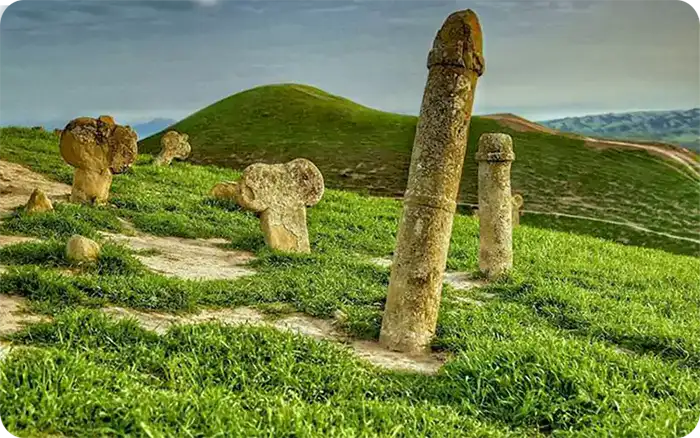
The most striking feature of the site is the large group of standing stones dispersed across the hills.
The exact number is uncertain. Some descriptions suggest more than 600 stones, while another archaeological study refers to a total approaching one thousand across different parts of the landscape.
A more recent study cautions that no reliable total can currently be established because the stones are widely scattered and have been affected by environmental degradation, displacement, and theft.
This uncertainty itself is significant. Historical photographs document examples that are no longer present in their former condition, demonstrating that the cemetery has changed considerably over time.
Cylindrical Standing Stones
The dominant group consists of cylindrical standing stones. In one academic classification, these stones range approximately from one to three meters in height and exceed 35 centimeters in diameter. Their upper sections often terminate in conical caps. Some caps are plain; others contain vertical grooves or circular bands.
The conical forms have been compared with the architecture of yurts used by Turkic and Central Asian nomadic societies. This does not necessarily mean that the stones reproduce yurts literally, but their forms have been interpreted as reflecting the visual culture of communities whose architectural traditions were strongly influenced by nomadic life.
Some stones also contain one, two, three, or—in historically recorded examples—four circular bands around their bodies. One hypothesis suggests that taller stones and those with a greater number of bands may have represented individuals of higher social status. However, the same research acknowledges that the precise significance of the bands remains difficult to determine.
Shorter and Ram-Horn Forms
Another group includes shorter stones whose horizontal or curved upper sections have been compared with the form of ram horns. The ram motif has deep significance in Turkmen and wider Central Asian visual culture.
The later comparative study argues that the ram was associated with power, blessing, fertility, martial strength, greatness, and nomadic life. Similar horn motifs occur in Turkmen carpets and other traditional decorative arts.
Some of the stones were previously interpreted as stylized human figures. Stronach, for example, compared certain examples with a man standing with his hands on his waist and wearing clothing associated with the Qajar period. More recent discussion emphasizes that at least some of these forms may be better understood in relation to the ram-horn tradition rather than as direct human representations.
Differences in Classification
The sources do not employ an identical typology. One study organizes the Khalid Nabi stones into three principal groups with several subtypes, whereas the archaeological paper presented at the Second National Conference of Iranian Archaeology identifies four principal types.
This distinction illustrates an important methodological issue: archaeological typologies depend on the characteristics selected by individual researchers. Therefore, the difference between three and four categories does not necessarily imply an irreconcilable disagreement.
5. Chronology: How Old Is the Cemetery?
The age of Khalid Nabi Cemetery remains one of its most important unresolved questions.
Most stones lack inscriptions, while surviving written examples are limited and do not provide a single chronology for the whole cemetery. The attached material explicitly states that determining the age of the shrines and the cemetery is difficult and that firm conclusions should be avoided until systematic archaeological excavation and testing are undertaken.
The more recent academic study reports pottery from several phases of the Islamic era, including early and middle Islamic periods as well as Seljuk and Safavid material. Based on this archaeological evidence and the assessments of cultural heritage specialists in Golestan Province, it regards the principal standing stones under study as belonging to the Islamic period.
Some later examples may belong to the Qajar period, while other comparisons have linked forms within the cemetery to earlier Islamic funerary traditions.
An earlier archaeological study proposed a possible association with the Aq Qoyunlu based partly on the use of ram symbolism. However, that same study emphasized the lack of comprehensive archaeological investigation as a limitation.
The popular compilation also records claims assigning the cemetery to very ancient or even Paleolithic times. Such statements are present in the attached material, but they are not supported by the archaeological evidence presented in the two academic studies. Consequently, they should not be presented as established archaeological conclusions.
6. Central Asian and Turkic Cultural Connections
One of the strongest themes in the academic sources is the relationship between the standing stones and broader Central Asian cultural traditions.
The comparative study of Khalid Nabi and Shadbad Mashayekh cemeteries concludes that the standing stones reflect cultural influences associated with Central Asian Turkic peoples as well as developments within Islamic funerary architecture.
The cylindrical body, conical cap, association with yurt forms, ram symbolism, and possible indicators of social rank collectively suggest a cultural environment shaped by nomadic and semi-nomadic traditions.
At the same time, Khalid Nabi should not simply be treated as identical to other cemeteries. Compared with the elaborate funerary pillars at Shadbad Mashayekh, which may contain inscriptions and architectural ornament, the principal Khalid Nabi stones are strikingly simple. The comparative study specifically notes the lack of elaborate Islamic calligraphy and architectural ornamentation on the Khalid Nabi examples.
Their simplicity is therefore one of their defining characteristics.
7. Oral Traditions and Local Memory
Scientific archaeology represents only one dimension of Khalid Nabi.
Local communities have developed numerous narratives explaining the stones. One tradition says that the enemies of Khalid Nabi were transformed into stone through divine intervention. Another claims that Khalid Nabi’s companions themselves became stone to escape capture.
Another local story concerns naturally rounded stones believed to represent watermelons that were transformed into stone. The attached source also records the presence of a votive tree near one of the shrines, where visitors tie threads and seek assistance for agricultural prosperity, livestock, fertility, and other needs.
From an academic perspective, these stories should not be used to explain the physical origin of the standing stones. Their importance lies elsewhere: they demonstrate how archaeological monuments become integrated into collective memory.
The archaeological site and the oral tradition therefore represent two different but interconnected forms of heritage—one material and the other intangible.
8. History of Research
The remote geographical setting appears to have limited systematic research at Khalid Nabi.
The attached compilation associates one early description with James Fraser’s nineteenth-century travel account. Later, David Stronach and William Royce undertook a major study of the standing stones, published in 1981 under the title Studies Standing Stones in the Atrek Region: The Hālat Nabī Cemetery. Subsequent Iranian researchers, including Manouchehr Sotoudeh and Rajab-Ali Labaf Khaniki, also examined the region.
Later archaeological and cultural-heritage investigations produced documentation for national registration and more detailed typological and comparative studies. The 2023 comparative paper cites the official registration report for the Khalid Nabi historical site prepared by cultural heritage specialists in Golestan Province.
Nevertheless, all three attached sources indicate in different ways that significant research questions remain unresolved.
9. Preservation Challenges
The survival of Khalid Nabi Cemetery cannot be taken for granted.
Natural weathering, exposed mountain conditions, displacement, human interference, and theft have affected the standing stones. The latest comparative study explicitly states that these factors make even an accurate count of the stones difficult.
Older documentation is especially important because several forms recorded in earlier photographs are now missing or altered.
Preservation therefore requires more than tourism management. It requires systematic archaeological documentation, photographic and three-dimensional recording, mapping of individual stones, monitoring of erosion, protection against unauthorized removal, and culturally sensitive engagement with local communities.
The archaeological study itself concludes by emphasizing the importance of preserving the cemetery for future generations.
10. Conclusion
Khalid Nabi Cemetery is important precisely because it cannot be reduced to a single explanation.
It is simultaneously a funerary landscape, a historical site, a place of pilgrimage, an expression of Turkmen cultural memory, and an archaeological problem that remains only partially understood.
Available archaeological evidence supports the interpretation of the principal standing stones within the Islamic period rather than claims of a prehistoric or Paleolithic origin. Their morphology indicates strong connections with the cultural world of Turkic and nomadic Central Asia, while motifs such as the ram horn reveal continuities with Turkmen symbolic traditions.
Yet many questions remain unanswered. The precise chronology of individual groups, the identity of the people buried beneath them, the significance of the circular bands, and the full historical sequence of the cemetery require further excavation and interdisciplinary study.
The legends surrounding Khalid Nabi should neither be confused with archaeological evidence nor dismissed as irrelevant. They form part of the intangible heritage through which local communities have interpreted and preserved the meaning of the landscape.
Ultimately, the greatest significance of Khalid Nabi lies in the interaction between landscape, death, memory, belief, and material culture. Its standing stones remain silent witnesses to a complex cultural history—and preserving them is essential if future research is to answer questions that current evidence cannot yet resolve.