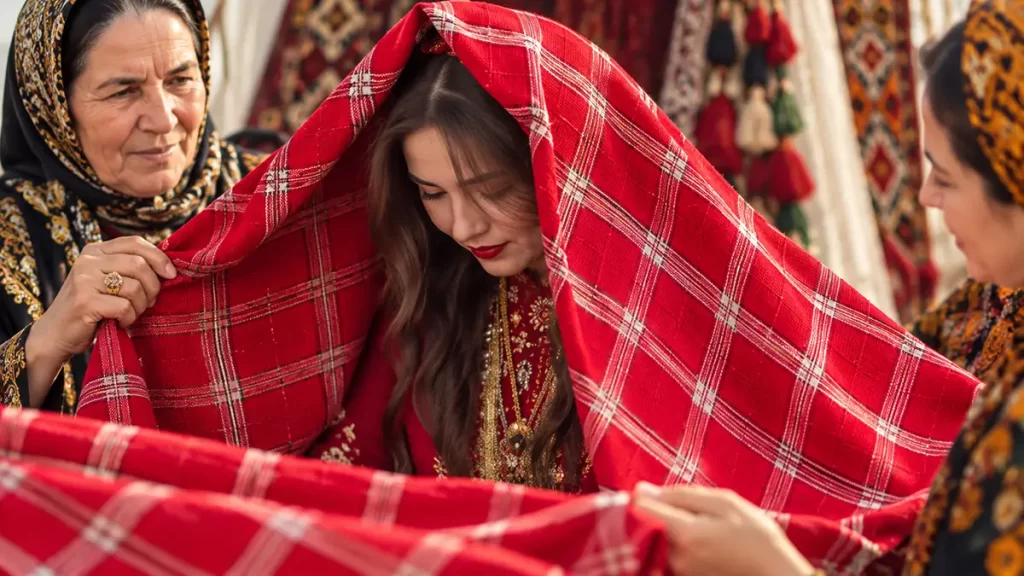
Chashu: The Turkmen Textile Woven Through Life, Marriage, and Memory
A red silk cloth, a wedding blessing, a women’s craft tradition, and a symbol carried through generations: Chashu is far more than a piece of traditional Turkmen clothing.
Across the Turkmen communities of northern Iran, a red woven textile appears in family memories, wedding ceremonies, traditional dress, silk-weaving traditions, and stories passed down from mothers and grandmothers.
It is known as Chashu, sometimes written as Chäshu.
At first glance, Chashu may seem simply to be a traditional Turkmen women’s covering. Look more closely, however, and a much larger story begins to emerge—one connecting the mulberry trees of Golestan, silkworm cultivation, women weavers, regional cultural exchange, marriage rituals, blessings for a bride, and even traditions associated with the beginning and end of life.
Perhaps most striking of all is the metaphor hidden in its weave.
The warp and weft come together to create a single fabric, yet they do not need to be tied into knots. In local interpretation, that structure has become a poetic image of marriage: two lives intertwined, moving forward together, without becoming caught in knots.
Chashu is therefore not simply something that was woven.
It is a story that has been woven.
What Is Chashu?
Chashu is a traditional textile associated with the clothing and ceremonial life of Turkmen women.
Historical and cultural descriptions of Turkmen dress record several varieties of Chashu, with differences in material, weave, pattern, and local use. Silk held particular importance, although not every example was necessarily made entirely from silk.
Chashu could function as a large head covering or outer textile and was especially visible in traditional wedding customs.
Its meaning, however, extended beyond fashion.
Traditional Turkmen clothing often communicated information about a person’s age, marital status, community, family life, and social position. A textile worn on the head or body could therefore carry cultural information recognizable to other members of the community.
Chashu belonged to this visual language.
Its fabric spoke before its wearer did.
Quick Facts About Chashu
- Culture: Turkmen
- Region: Particularly associated with Turkmen communities in Golestan Province, northern Iran
- Traditional material: Often associated with silk, though materials and techniques varied
- Typical appearance: Red or red-dominant woven patterns are common in remembered and surviving examples
- Uses: Women’s clothing, wedding ceremonies, family traditions and, in documented cases, funeral customs
- Related craft traditions: Sericulture, silk spinning, dyeing and hand weaving
- Cultural significance: Marriage, continuity, women’s knowledge, family memory and cultural identity
From Mulberry Leaves to Silk: Where the Story Begins
The story of silk Chashu does not begin at the loom.
It begins with a tree.
Silkworms depend on mulberry leaves for food, which means that traditional silk production could only flourish where environmental conditions allowed mulberry cultivation and sericulture to develop.
Parts of Golestan Province provided exactly those conditions.
The forested and foothill landscapes around areas inhabited by Göklan Turkmens became associated with silk production. Historical geographical descriptions of the Göklan region mention mulberry cultivation, silkworm breeding, silk production and the weaving of silk textiles by women.
Nearby areas such as Kalaleh, Minudasht and Ramian also developed strong textile and silk-weaving traditions.
The landscape therefore became part of the cloth.
Behind every silk thread was a sequence of natural and human labor:
mulberry leaves feeding silkworms, cocoons being collected, silk fibers being drawn and prepared, threads being dyed, the loom being arranged, and finally a weaver bringing warp and weft together.
A finished Chashu was the visible end of a much longer cultural process.
The Women Behind the Weave
The history of Chashu is also a history of women’s knowledge.
Across many traditional textile cultures, weaving skills were not primarily preserved in written manuals. They were learned by watching, helping, repeating and remembering.
Knowledge passed from one generation of women to another.
Women participated in preparing fibers, handling silk, arranging threads, weaving textiles, storing valuable fabrics, preparing clothing for ceremonies and teaching younger family members when and how particular garments should be used.
For that reason, calling Chashu simply “women’s clothing” misses an important part of its significance.
It is also evidence of women’s craftsmanship, memory and cultural transmission.
A textile preserved for decades inside a family chest may contain knowledge that never entered an archive.
A grandmother may remember which Chashu belonged to which relative, when it was worn, how it was folded and what happened during the ceremony in which it appeared.
These memories are historical sources in their own right—even when they must be carefully distinguished from documented historical facts.
The Meaning Hidden in the Warp and Weft
One of the most compelling interpretations of Chashu comes from the structure of the fabric itself.
In weaving, longitudinal threads form the warp, while another thread—the weft—passes repeatedly through them.
Together, separate threads become one fabric.
Yet woven cloth is not produced through the same knotting process associated with knotted carpets.
That distinction has inspired a powerful metaphor in oral tradition.
A married couple, like warp and weft, are two separate lives.
Marriage brings them together.
Their paths become intertwined.
But the hope is that their shared life will continue without knots.
This interpretation should not be presented as a technical explanation for the historical origin of Chashu. It is better understood as a poetic cultural reading of the textile.
But that does not make it insignificant.
On the contrary, it shows how material culture becomes language.
People look at an object they know intimately and use its physical characteristics to express ideas about love, marriage, family and the kind of life they hope the next generation will build.
Why Does a Turkmen Bride Wear Chashu?
The wedding ceremony is one of the moments in which Chashu acquires its strongest symbolic meaning.
In traditional accounts of Turkmen bridal customs, a distinctive covering—often red—is placed over the bride as she prepares to leave for the groom’s household.
The moment marks a transition.
She is still the daughter of one household, yet she is about to enter another family and begin a different stage of life.
In some descriptions of traditional wedding ceremonies, a woman from the groom’s side places the Chashu over the bride. Regional forms of the ceremony may also include symbolic exchanges between women of the two families.
Against this background, the warp-and-weft metaphor becomes particularly powerful.
The textile placed over the bride is no longer merely a covering.
It can be read as a wish:
May these two lives become beautifully intertwined.
May they remain connected.
And may their shared path remain free of unnecessary knots.
Flour on the Bride’s Chashu: A Blessing for a Bright Future
Another memorable ritual involves something extraordinarily simple: flour.
In some recorded versions of Turkmen wedding practice, after the bride arrives at the groom’s home, the groom’s mother sprinkles white flour over her Chashu.
White carries an obvious visual association with brightness and good fortune.
The gesture becomes a blessing for the new bride—a wish for prosperity, happiness and what Persian-speaking communities often describe as being “white-fated” or sefidbakht, meaning fortunate in married life.
Other oral accounts attribute a similar ritual to the bride’s mother.
Rather than forcing these versions into a single standardized ceremony, their differences should be documented.
Traditional customs frequently vary between tribes, villages, families and historical periods.
One community may preserve a ritual differently from another just a short distance away.
The central meaning, however, appears remarkably consistent:
a mother wishes brightness, blessing and good fortune for a young woman beginning a new life.
Did Qizilbash Culture influence Chashu?
One local narrative connects the history of Chashu with long-term contact between Turkmen communities and neighboring Qizilbash populations.
The geography makes cultural interaction entirely plausible.
Golestan has long been home to different communities living in proximity to one another. Ramian, the foothills around Gorgan, Minudasht and surrounding settlements developed their own textile traditions, while Göklan communities also maintained traditions of silk production and weaving.
Objects, techniques, patterns and customs rarely respect strict ethnic boundaries.
People trade.
Families travel.
Artisans observe one another.
Neighbors borrow techniques.
Styles change.
For this reason, cultural exchange almost certainly played a role in shaping textile traditions across the region.
However, there is an important distinction between cultural contact and a proven line of direct historical transmission.
The claim that Chashu was specifically introduced into Turkmen culture from Qizilbash culture remains better treated as an oral or local historical narrative unless stronger documentary evidence establishes that connection.
That distinction matters.
Protecting cultural heritage does not require turning every remembered story into a proven historical fact.
Recording uncertainty is itself part of responsible cultural preservation.
Chashu and the Three Stages of Life
One of the most powerful narratives surrounding Chashu places the textile at three defining moments:
birth, marriage and death.
According to some oral family traditions, a newborn could be wrapped or covered in silk Chashu at the beginning of life.
During marriage, Chashu appears again as the bride crosses into a new household.
And at death, silk Chashu may accompany a person once more.
The funeral use is supported by written descriptions of Turkmen cultural practice in which a silk Chashu is placed over the deceased or the coffin and accompanies the funeral procession toward burial.
The newborn tradition is less clearly documented in the written material currently available and should therefore be treated primarily as an oral tradition until broader field research confirms how widespread the practice was.
Still, the symbolism is extraordinary.
If one cloth can appear at birth, marriage and death, it ceases to be simply clothing.
It becomes a witness to the human life cycle.
Why Is Chashu Often Red?
Red is among the most visually striking characteristics of many surviving or remembered Chashu textiles.
It also occupies a prominent place in broader Turkmen material culture—from textiles and clothing to carpets and embroidery.
In modern interpretations, red may be associated with life, celebration, vitality, happiness or youth.
But historical symbolism is rarely universal.
Different Turkmen communities may have interpreted colors differently, and meanings can shift over generations.
It is therefore safer to say that red is an important and highly visible feature of the tradition than to assign one definitive symbolic meaning to it.
This is a broader lesson for anyone studying traditional culture:
variation is not evidence that a tradition is inauthentic.
Variation is often evidence that the tradition was alive.
A Textile Shaped by a Cultural Landscape
Chashu belongs not only to a community but also to a landscape.
Northern Iran’s Golestan Province contains plains, forests, mountain foothills and long-standing agricultural settlements. Communities living across this geography developed different forms of livelihood and craft production.
Silk connected several of them.
In areas where mulberry trees could flourish, silkworm cultivation became possible. Where silk was available, weaving traditions developed. Where communities lived beside one another, styles and knowledge could circulate.
The history of Chashu is therefore not the history of an isolated object.
It sits at the intersection of environment, craft, ethnicity, gender, economy and ritual.
This is one reason why studying traditional textiles can reveal so much about the societies that created them.
A piece of cloth can become a map.
Why Documenting Chashu Matters Today
Cultural heritage does not disappear only when an object is destroyed.
It can disappear when its meaning is forgotten.
A family may still possess an old Chashu but no longer know who wove it.
A ceremony may continue even after the original terminology has faded.
A grandmother may remember a local name for a weaving technique that younger generations have never heard.
Once that knowledge disappears, recovering it becomes difficult.
This is why Chashu requires more than admiration.
It requires documentation.
Researchers and community organizations can help by recording interviews with elders, photographing surviving textiles, identifying regional weaving patterns, documenting local terminology, recording the biographies of women weavers and comparing traditions between communities.
Particular attention should be paid to differences among Göklan, Yomut and other Turkmen groups, as well as neighboring weaving traditions in places such as Ramian and Minudasht.
Even contradictions are valuable.
If one village says the groom’s mother sprinkled flour while another remembers the bride’s mother doing it, both accounts should be recorded with their location and context.
That is how cultural history becomes richer rather than flatter.
Chashu Is More Than a Textile
Imagine the full journey.
A mulberry tree grows in northern Iran.
Its leaves feed silkworms.
Cocoons are collected.
Silk is drawn into thread.
The thread is prepared and dyed.
A woman sits before a loom.
Warp and weft slowly become fabric.
The cloth is folded and preserved.
Years later, it appears at a wedding.
A young bride lowers her head as Chashu is placed over her.
Someone scatters white flour and wishes her a fortunate life.
The textile passes back into family memory.
Perhaps decades later, it appears again in another ceremony.
This is how ordinary objects become cultural heritage.
Not because they remain unchanged forever, but because generations continue to give them meaning.
Chashu carries traces of women’s labor, regional history, silk production, marriage, family memory and Turkmen identity.
Its threads connect craft with ritual.
Its rituals connect families with history.
And its history connects the past with a generation now deciding what should be preserved for the future.
Chashu is not simply a cloth inherited from the past.
It is a living thread between generations.
Frequently Asked Questions About Chashu
What is Chashu in Turkmen culture?
Chashu is a traditional textile associated with Turkmen women’s clothing and ceremonial customs. Silk versions are particularly significant, and the textile is strongly associated with wedding traditions and cultural memory in Turkmen communities of northern Iran.
Is Chashu the same as a Turkmen headscarf?
It can function as a head or body covering, but describing Chashu simply as a headscarf understates its size, traditional uses and ceremonial significance. Its form and use have also varied by region and community.
Why is Chashu used in Turkmen weddings?
Chashu is traditionally associated with the bride’s transition into married life. In oral interpretations, its interwoven warp and weft symbolize two lives becoming connected while remaining free of “knots.”
Why is flour sprinkled on a Turkmen bride?
Some Turkmen wedding traditions include sprinkling white flour over the bride or her Chashu. The gesture is understood as a blessing for good fortune, prosperity and a bright married life. Accounts differ over which family member traditionally performs the ritual.
Is Chashu made from silk?
Silk Chashu is particularly important in traditional accounts, although materials and weaving styles have varied. Its history is closely connected with sericulture and traditional silk production in parts of Golestan Province.
Where was Chashu traditionally produced?
Silk weaving and textile production have historical associations with Turkmen areas around Kalaleh and the Göklan region, as well as neighboring centers such as Ramian and Minudasht in Golestan Province.
Is Chashu still used today?
The extent of everyday use has changed, but Chashu remains culturally significant through weddings, traditional ceremonies, surviving family textiles, cultural events and efforts to preserve Turkmen heritage.
A Call to Preserve the Story
Much of the history of Chashu remains inside homes rather than libraries.
Old photographs, wedding memories, inherited textiles, local names, family stories and the knowledge of elderly women may hold details that have never been formally documented.
Turkmen Students and Graduates (@turkmenstudents) invites elders, researchers, weavers, artists and Turkmen families to share photographs, memories and regional accounts related to Chashu.
Recording these stories today may determine how much of this heritage survives tomorrow.